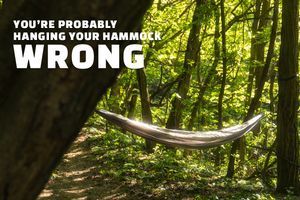
Hammocks have been around for centuries — yet somehow, a handful of persistent myths keep people from using them the right way, or from trying them at all. Whether you're a first-time camper or a seasoned backcountry traveler, you've probably heard at least one of these: "sleeping in a hammock wrecks your back," "you'll be eaten alive by insects," "hammocks are only for summer."
We're here to set the record straight. In this article, we break down the five most common hammock myths and show you exactly what the reality looks like — with photos and practical guidance so you can hang with confidence.
Myth #1: Sleeping in a Hammock Is Uncomfortable
This is the biggest one. And honestly, it's understandable — if you've ever tried to sleep flat on your back in a hammock like a rigid plank, you've probably woken up sore and stiff. But here's the thing: that's not how you're supposed to lie in a hammock.
The Fix: Go Diagonal
The correct sleeping position in a hammock is diagonal — not straight along the centerline. When you shift your body at a 20–30 degree angle to the long axis of the hammock, the fabric flattens out beneath you, your spine stays neutral, and you stop feeling like a banana in a peel.

Left: Diagonal position — flat, comfortable, spine-friendly ✓ | Right: Straight along the centerline — the "banana" — avoid this ✗
The diagonal position allows the hammock to support your entire back evenly. Many hammock sleepers report that once they made this adjustment, they started sleeping better outdoors than they do in a tent — or even at home.
Pro tip: If you feel your legs sinking lower than your torso, try hanging the foot-end of the hammock 20–25 cm higher than the head-end. This small tweak makes a noticeable difference in overnight comfort.
Myth #2: A Hammock Leaves You Exposed and Vulnerable
The image of a person swinging in an open hammock, unprotected from insects above and the ground below, is a common one. But modern hammock setups are specifically designed to solve both of these problems.
Protection from Above: The Mosquito Net
A quality hammock mosquito net (bug net) encases your entire sleeping area from above, creating a sealed barrier against mosquitoes, midges, and other insects. When viewed from inside, the net acts like a personal shelter — you have full visibility of your surroundings, but nothing flying can get to you.

This is especially valuable during warm-season camping in forested or lakeside environments, where insect pressure can be intense after dark. A good bug net doesn't just keep insects out — it also gives you a surprising sense of enclosure and calm that makes falling asleep easier.
Protection from Below: Ground Clearance
There's another layer of "exposure" people worry about: being close to the ground, to wet grass, rocks, or small animals. In practice, proper hammock setup puts you well above all of it.

The recommended hang height is 30–60 cm from the ground (with 20–40 cm as the sweet spot when loaded). This keeps you clear of ground moisture, crawling insects, and uneven terrain — three things that actually make tent sleeping more miserable than people admit.
Myth #3: A Hammock Is Only for Summer
This one stops a lot of people from investing in hammock camping as a year-round system. The assumption is that a hammock leaves you suspended in cold air on all sides, making it inherently unsuitable for cold weather. That assumption ignores one crucial piece of gear: the underquilt.
Cold-Weather Hammock Camping Is Very Real
In a tent, your sleeping pad insulates you from the cold ground. In a hammock, the equivalent is an underquilt — an insulating layer that hangs beneath the hammock body, trapping warm air below you and preventing heat loss through the fabric.
Combined with a top quilt or sleeping bag above, a properly configured hammock system is genuinely warm in sub-zero temperatures — and is used by cold-weather hikers, winter backpackers, and ultralight campers across Scandinavia, the Alps, and North America throughout the year.

Winter is also a season. In fact, hammock camping in winter has several advantages over tents: no frozen ground to contend with, no condensation pooling inside the shelter, and setup that works on any two trees regardless of snow depth on the ground.
For three-season and winter use, a tarp rigged above the hammock completes the system — shedding rain, snow, and wind while keeping weight minimal.
Myth #4: Tree Straps Damage Tree Bark
This is a genuine environmental concern, and it deserves a thoughtful answer. The short version: the strap itself doesn't cause damage — improper straps do.
Width Is Everything
The problem with old-school hammock suspension (thin rope, paracord, or narrow webbing) is that a narrow line concentrates pressure into a small area of bark, which can cut into the cambium layer beneath — the living tissue of the tree.
Modern hammock straps are specifically designed to be wide enough to distribute load across a large surface area of bark. When a strap of 25 mm width or more is laid flat against a tree and tensioned correctly, the contact surface is broad, the pressure per square centimeter is low, and the bark is not compressed in a way that causes lasting harm.

The key behaviors that protect trees:
- Use wide straps (20 mm or wider) — never thin cord or rope
- Make sure the strap lies completely flat against the bark, with no twisting or bunching
- Wrap at least once around the trunk — never just a single pass-through
- Avoid the same trees repeatedly on popular campsites — let bark recover
When these practices are followed, responsible hammock camping is genuinely low-impact. Many land managers and Leave No Trace educators now distinguish between harmful and responsible hammock use based specifically on strap width and technique.
Myth #5: Hammocks Are Complicated to Set Up
This isn't one of the original five myths — but it comes up so often in conversation that it's worth addressing as a bonus.
A well-designed hammock with an intuitive suspension system can be set up in under two minutes, even in the dark, even by a beginner. The learning curve is short: find two trees 3–4.5 meters apart, wrap the straps, clip in, adjust tension. That's it.
The complexity people imagine comes from outdated hammock designs that required knot-tying, cord-running, and fiddly adjustments. Modern systems with integrated G-hooks, quick-adjust buckles, or ridgeline attachments have removed almost all of that friction.
Summary: What Actually Matters in Hammock Camping
| Myth | Reality |
|---|---|
| Hammocks are uncomfortable | Lie diagonally — flat back, no banana |
| You're exposed to insects and the ground | Bug net above, 30–60 cm clearance below |
| Hammocks are summer-only | Underquilt + tarp = full winter system |
| Straps destroy trees | Wide, flat straps distribute pressure safely |
| Setup is complicated | Modern systems are 2-minute jobs |
The common thread through all five myths is the same: the hammock isn't the problem — technique and equipment choice are. Get those right, and a hammock becomes one of the most comfortable, versatile, and low-impact ways to sleep outdoors.
Have questions about hammock setup, suspension, or cold-weather gear? Browse more guides on the Leleka blog — or reach out directly. We're happy to help you find the right system for the way you camp.